How to Start a Bike Rental Business in Malta: A Practical Guide for 2026
How to start a bike rental business in Malta: company registration, VAT, licences, insurance, location, fleet and seasonality, with official sources.
To start a bike rental business in Malta you need a legal structure (sole trader or limited company), a VAT registration that fits your turnover, the right insurance, a well placed pick-up point and a fleet sized for a very seasonal market. This guide walks through each step with the official sources, and flags the points you should confirm with the authorities before you open.
Step 1: choose your legal structure
Most small rental operators in Malta start in one of two ways: as a self-employed sole trader, or through a private limited company (Ltd). The government's Business 1st portal explains that sole traders register with Jobsplus as self-employed, using a single online form that also covers VAT and, if needed, employer registration. Maltese citizens already have a tax number; EU citizens first need a social security number and an income tax number.
A limited company is registered with the Malta Business Registry (MBR), and a tax identification number is issued automatically on registration. Under article 72 of the Companies Act, a private company needs an authorised share capital of at least EUR 1,164.69, and at least 20 per cent of the nominal value of each share taken up must be paid up when the memorandum is signed. Single-member companies are allowed. According to the MBR fee table consulted in October 2026, electronic registration costs EUR 100 when the authorised share capital does not exceed EUR 1,500.
Sole trader or limited company?
- Sole trader: quicker and cheaper to set up, but you are personally liable for the debts of the business.
- Limited company: limits your liability to the company's assets, which matters when you rent out vehicles to the public, but brings annual filings and accounting costs.
Step 2: get VAT right from the start
Malta's standard VAT rate is 18 per cent (Value Added Tax Act, Cap. 406). Since 1 January 2025, a business whose domestic annual turnover stays under EUR 35,000 can choose the exempt registration under article 11: you do not charge VAT, but you cannot recover the VAT you pay on bikes, parts or rent. Above that threshold, or if you prefer, you register under article 10, charge VAT and deduct input VAT.
For a rental business that buys a fleet up front, article 10 is often attractive because the VAT on the bikes can be recovered. Run the numbers on both options with your accountant.
Which rate applies to bike hire?
This is the point to check carefully. The Eighth Schedule of the VAT Act applies 7 per cent to the use of sporting facilities, and VAT Department guidelines issued in 2017 extended it from 2018 to movable equipment used exclusively for physical activity. Some websites state that bike rental is taxed at 7 per cent, but bike hire is not named in the Act itself, and a rental for getting around may be treated differently from a sporting use. Minor repairs of bicycles are listed at 5 per cent. Ask the Commissioner for Revenue (MTCA) or your accountant for a written answer before you set your prices.
Check the rate for bike hire in writing before you set your prices.
- 18%Standard VAT rate
Applies unless a reduced rate is set by law.
- EUR 35,000Article 11 threshold
Below this domestic turnover, exempt registration is possible.
- 7%Use of sporting facilities
Bike hire is not named in the Act.
- 5%Minor repairs of bicycles
Listed in the Eighth Schedule.
Step 3: licences, permits and what to confirm
We found no licence called a bike rental licence in Maltese law. What matters is the kind of service you offer.
- Trade licences: the Commerce Department's trade licensing unit covers specific activities such as hawkers, market stalls, door-to-door sales and fairs. A fixed rental shop is not on that list, but check the Licences and Permits section of Business 1st for your exact activity.
- Vehicle hire: Transport Malta licenses vehicle hire operators under S.L. 499.68, and the definition of motor vehicle in those regulations includes low-powered cycles, which cover power-assisted bicycles. If you plan to rent e-bikes, ask Transport Malta's Land Transport Directorate in writing whether your fleet needs a vehicle hire operator licence.
- Guided tours: under the Malta Travel and Tourism Services Act, an organised excursion is any tour for five or more people, its operator needs a licence from the Malta Tourism Authority, and a licensed tourist guide must be provided. Plain rentals are not excursions, but group rides you lead are.
- Premises: make sure the unit you rent is permitted for commercial use, and ask the Planning Authority or your local council before installing racks or signs on the pavement.
Step 4: insurance and equipment rules
The Low-Powered Vehicles and Pedal Cycles Regulations (S.L. 65.26) require third-party insurance only for power-assisted cycles with a motor above 250 watts. Ordinary bikes and standard 250 W pedelecs have no compulsory insurance under that text, but a rental business without liability cover is taking a real risk. Ask a Maltese broker for a policy that covers third-party liability for your customers, theft and damage to the fleet, and your premises.
The same regulations set the equipment every bike you hand over must carry:
- a working bell or horn;
- a white front lamp, a red rear lamp and a red rear reflector;
- and, for riding after dark, the rider must wear reflective strips or a reflective vest, so keep some at the counter.
Brief your customers too: cycling is not allowed on promenades, footpaths, pedestrian subways or road tunnels unless signs say otherwise, and riders must keep to the left. A printed or digital rental agreement that records these rules, the bike's condition and the deposit protects you if something goes wrong.
- 01A bell or horn
In working order on every bike.
- 02Front and rear lamps
White at the front, red at the rear.
- 03A red rear reflector
Fitted to every bike you hand over.
- 04Reflective vest or strips
Worn by the rider after dark: keep some at the counter.
- 05Rules explained
No promenades, footpaths or tunnels unless signed; keep to the left.
- 06Liability cover
Not compulsory at 250 W, but a real risk without it.
Step 5: pick your location and your customers
Malta welcomed 4,022,310 inbound tourists in 2025, 12.9 per cent more than in 2024, according to the National Statistics Office (NSO). The same NSO release shows that 57.3 per cent of them visited Gozo and Comino, so the sister island is far from a niche. Your location decides who walks in:
- Seafront and hotel areas such as Sliema, St Julian's or Bugibba: walk-in tourists, short rentals, strong demand for e-bikes.
- Near the Cirkewwa ferry terminal or in Gozo: day trippers and multi-day touring. Gozo Channel charged EUR 1.15 for a bicycle on the ferry in October 2026.
- Residential towns: residents and long-stay foreigners, monthly rentals and repairs, less seasonal.
- No shop at all: delivery to hotels and holiday flats, which keeps rent low but needs a van and good scheduling.
Step 6: build a fleet for a seasonal market
Demand in Malta is real all year but far from flat. NSO counted 210,305 inbound tourists in February 2025 and 470,643 in August 2025, more than twice as many. Size your fleet for the shoulder seasons, when cycling weather is most pleasant, rather than for the August peak, and add bikes only when your booking data proves the demand.
- Start with a mix: city or hybrid bikes for flat seafront rides, e-bikes for the hilly interior and for Gozo, and a few child seats or kids' bikes.
- Standardise brands and sizes so spare parts and repairs stay simple.
- Budget for maintenance from day one: tyres, brakes and chains wear fast with salt air and dust.
- Check Transport Malta's 2026 grant schemes: one of them supports businesses buying up to 50 bicycles to be offered for hire, and another the conversion of bicycles to pedelecs. Read the conditions on transport.gov.mt before you order.
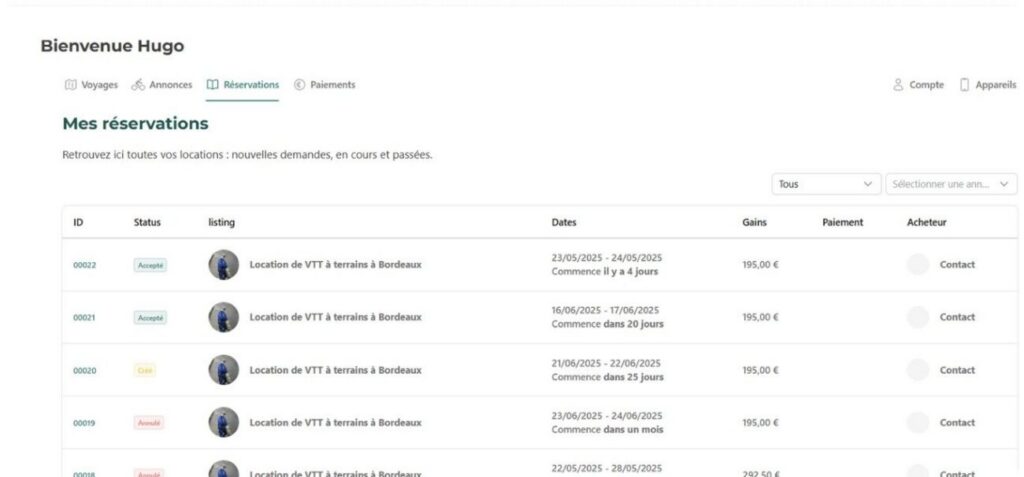
Step 7: set up your booking and management tools
Most visitors to Malta plan their activities online, often from their hotel room the night before. If they cannot see availability and book in a few clicks, they book someone else. From the first season you need:
- an online booking page in English, ideally in the languages of your main markets as well;
- online payment of a deposit or the full amount, plus a security deposit you can release without paperwork;
- a real-time view of which bike is out, returning or in the workshop, to avoid double bookings;
- multi-day prices that calculate themselves, and add-ons such as helmets, child seats or delivery.
A spreadsheet works for five bikes. Beyond that, a dedicated tool saves hours every week. Our guide to choosing bike rental software in Malta compares the features that matter, and the article on pricing bike rentals in Malta helps you set day rates, multi-day discounts and deposits.
Frequently asked questions
Do I need a specific licence to rent bicycles in Malta?
No licence named specifically for bike rental appears in the texts we checked. Your company or self-employed registration and VAT registration are required. If you rent e-bikes, ask Transport Malta whether the vehicle hire rules (S.L. 499.68) apply to you, and if you guide groups of five or more, you need an organised excursion licence from the Malta Tourism Authority.
What VAT do I charge on bike rentals in Malta?
The standard rate is 18 per cent. A reduced 7 per cent rate exists for the use of sporting facilities, including some movable equipment, but bike hire is not named in the VAT Act. Get a written answer from the MTCA or your accountant before setting prices. Below EUR 35,000 of domestic turnover you can opt for the article 11 exempt registration.
How much capital do I need to open a limited company in Malta?
The Companies Act sets a minimum authorised share capital of EUR 1,164.69 for a private company, with at least 20 per cent paid up on signing the memorandum. Registration fees are on top, starting at EUR 100 for electronic registration with a small capital according to the MBR fee table in October 2026.
Is insurance compulsory for a bike rental business in Malta?
S.L. 65.26 requires third-party insurance only for power-assisted cycles above 250 watts. For ordinary bikes and 250 W pedelecs it is not compulsory under that text, but liability, theft and damage cover is strongly advisable for any business renting to the public.
When is the high season for bike rental in Malta?
Tourist arrivals peak in summer: NSO counted 470,643 inbound tourists in August 2025 against 210,305 in February 2025. Spring and autumn usually offer the most comfortable cycling weather, so they matter as much as the summer peak.
Starting a bike rental business in Malta is mostly about getting the basics right: a clear legal structure, a VAT choice that fits your plans, written answers from the authorities on the grey areas, solid insurance and a fleet sized for the seasons. Once that is in place, the difference is made by how easily tourists can find you and book. BikUp Pro is a management and online booking tool built with independent bike rental operators, with fleet planning, online payment, pre-authorised deposits and a booking site in your own colours. See what it does or join the beta programme: beta testers get six months free.
Join the BikUp Pro betaAlso worth reading
A free bike rental profitability calculator for rental shops
Free bike rental profitability calculator: revenue, break-even occupancy and payback period in about three minutes, with no sign-up.
Read the article →
Bike Rental Pricing in Malta: Daily Rates, Multi-Day Discounts, Deposits and VAT
Bike rental pricing in Malta and Gozo in 2026: daily rates, multi-day discounts, seasons, deposits and VAT, plus a method to set yours.
Read the article →
Running a Gozo Bike Rental Business: Ferry, Seasons, Guests and Delivery
How to run a Gozo bike rental business: the Gozo Channel ferry, summer peaks, who rents, delivery to guests and accommodation partnerships.
Read the article →