Bike Rental Seasonality: How to Forecast, Fill the Low Season and Smooth Your Revenue
Bike rental seasonality explained with 2025 data: forecast your peak, fill the low season with locals, companies and schools, smooth revenue.
Bike rental seasonality is steep: in 2025, July and August alone held 31% of all nights spent in EU tourist accommodation, and on rural cycle routes August traffic was nearly 13 times that of January. You cannot flatten that curve, but you can forecast it, stretch the shoulder seasons and add customers who ride all year. This guide shows how, with figures you can check.
What the seasonal curve really looks like
A tourist bike rental follows the tourism calendar, and Eurostat measures that calendar precisely. In 2025, August was the busiest month in every EU country, with 501 million nights spent in tourist accommodation, 3.6 times more than in January (139 million). July and August together accounted for 31% of the year's nights.
The curve depends heavily on where you are and who you serve:
- Destination: in Croatia, 55% of 2025 tourism nights fell in July and August; in Malta, only 22%, the flattest profile in the EU. A Mediterranean island and a Baltic coast do not have the same low season.
- Type of guest: campsites recorded 63% of their nights in the third quarter of 2025 and just 3% in the first. Hotels were more even, with 36% in the third quarter. If your customers sleep under canvas, your winter is long.
- Rural versus urban riding: on French counters in 2025, rural sites saw 317 cyclists a day in August against 25 in January, nearly 13 times more, according to Réseau vélo et marche. In large cities the gap was only 1.5 times between June or September and the winter months, and August was below the annual average.
In short, a leisure rental on a cycle route lives on a few summer weeks, while a city shop sees steadier, commuter-driven demand. Most rentals sit somewhere in between, and the rest of this guide is about moving yours towards the steadier end.
Nights spent in EU tourist accommodation, 2025.
- 31%Of the year’s nights in July and August
Across the whole EU.
- 3.6 timesMore nights in August than in January
501 million against 139 million.
- 63%Of campsite nights in July to September
Against 3% in January to March.
- 55%Of Croatia’s nights in July and August
Against 22% in Malta, the flattest profile.
Forecast your own season before you plan anything
Public statistics give the shape of the curve; your own bookings give its height. Before buying bikes or hiring staff, build a simple month-by-month forecast.
- Export at least one full year of bookings and count rental days per month and per bike category, not just revenue.
- Compare each month's rental days with the number of bikes available: utilisation shows when you turn customers away and when bikes sit idle.
- Mark the school holidays of your main source markets. According to Eurydice, summer holidays last from 6 to 14 weeks depending on the country, 10 on average, and France, Switzerland and the French Community of Belgium have up to four two-week breaks in the year. Its school calendar tool lists the dates country by country.
- Add local events, public holidays and long weekends, then note the weather on your slowest days to separate bad luck from true low season.
- Watch booking lead times: if summer customers book weeks ahead, the state of your calendar in spring is your best early indicator.
A forecast like this tells you how many bikes to keep at peak, when to schedule repairs and when to push offers. It also gives you a baseline to measure whether your low-season actions actually work.
Stretch the shoulder seasons
The cheapest extra revenue is usually in the weeks just before and after the peak, when visitors are still around but your bikes are not fully booked. Eurostat notes that the season extends further into September for international tourists: September accounted for 11% of nights spent by foreign guests in 2025, against 9% for domestic travellers.
- Target cyclists who avoid the heat: spring and autumn are often the best riding months, which is a selling point for active travellers. Our guide to cycle tourism customers details who they are.
- Promote e-bikes outside summer: shorter days and cooler weather make assistance more attractive for longer outings.
- Package the experience: a rental with a suggested route, a picnic stop or a partner winery is easier to sell midweek than a bare bike.
- Use seasonal prices, but keep them simple: a clear low-season rate or a multi-day discount works better than constant price changes. See how operators structure this in our article on bike rental pricing.
- Open online booking early so that spring and autumn customers can secure a bike in advance instead of finding a closed shop.
Win locals with long-term rentals
Residents ride all year and do not depend on school holidays. The challenge is that they rarely need a bike for a day; they need one for weeks or months.
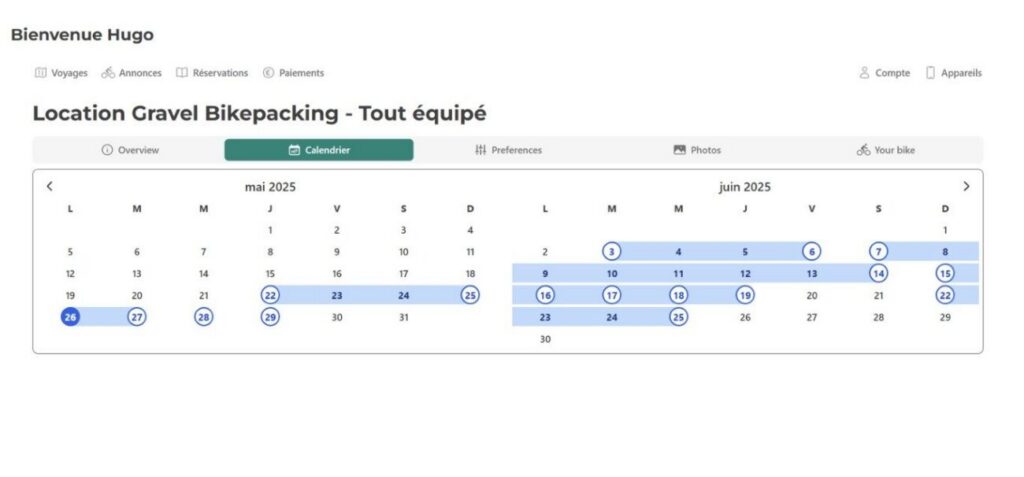
Long-term rental is a proven format. In the Paris region, the public Véligo Location service rents bikes for 3 to 12 months, from €10 a month for a standard bike to €88 for an electric cargo bike, with €44 a month for an e-bike in 2026, according to the Île-de-France Region. You will not compete with a subsidised public scheme, but it shows that monthly rental is a product customers understand.
Who can rent long term
- Students and seasonal workers who stay a few months.
- Residents testing an e-bike before buying one.
- People whose own bike is being repaired, or who need a cargo bike for a few weeks.
- Winter visitors and remote workers on long stays.
Long rentals smooth revenue and occupy bikes that would otherwise wait for summer. Set a clear monthly price, a deposit, a servicing schedule and a return condition check, and keep enough bikes back for the peak.
Bring in companies and schools
Employers increasingly pay for cycling to work, and the schemes differ by country. Check the current rules with an accountant before building an offer on them.
- France: an employer can pay a sustainable mobility allowance (forfait mobilités durables) of up to €600 per employee per year free of tax and social charges, or €900 combined with a public transport pass, and bike rental is an eligible cost.
- Belgium: in 2026, a bike commuting allowance is exempt up to €0.37 per kilometre, with an annual cap of €3,700 per employee.
- Germany: company bike leasing is a large market. In 2025, about 720,000 bikes were newly leased through employers, 342,000 employers offered the scheme and 2.4 million people rode a leased bike, according to Deloitte and Zukunft Fahrrad.
For a local rental, the realistic B2B offers are pool bikes rented to a company by the month, trial periods for employees before a leasing decision, team-building rides and bikes for hotels or campsites that do not want to manage a fleet.
Schools and youth groups
Schools and holiday clubs book outside the tourist peak. In France, the Savoir rouler à vélo programme teaches children aged 6 to 11 in at least ten hours, delivered by schools, clubs, associations and local authorities. Organisers of such sessions sometimes lack bikes or helmets in the right sizes: contact them before the school year starts.
Use the quiet months to prepare the next peak
Low season is not only a revenue problem; it is the only time you can work on the fleet without losing bookings.
- Service every bike in depth: drivetrain, brakes, tyres, bearings. A breakdown in August costs far more than a part replaced in February.
- Store e-bike batteries following the manufacturer's instructions, typically partly charged and away from frost, and check them before spring. Our guide to the e-bike rental market covers the fleet side.
- Sell or retire the bikes that cost too much in repairs and plan purchases early, when suppliers can deliver before the season.
- Update your website, photos, prices and terms, and ask last season's customers for reviews.
- Train seasonal staff before the rush, not during it.
- 01Forecast
Count rental days per month and mark your markets’ school holidays.
- 02Shoulder seasons
Sell spring and autumn rides, e-bikes and packages.
- 03Long-term rentals
Rent by the month to students, residents and winter visitors.
- 04Companies
Offer pool bikes, trial periods and team rides.
- 05Schools and groups
Equip cycling lessons and holiday clubs outside the peak.
- 06Preparation
Service the fleet, store batteries and update your website.
Protect your cash flow across the year
Even with a fuller low season, most of the year's cash will arrive in a few months. Plan for it.
- Take deposits on advance bookings so that peak revenue starts arriving in spring.
- Keep fixed costs as low as the season allows: seasonal staff contracts, flexible storage, a smaller winter opening schedule.
- Set aside part of the summer revenue to cover winter rent, insurance and loan repayments.
- Track bookings already taken for the coming months, not only revenue earned, so you can adjust spending early.
Seasonality also shapes how you invest. Buying ten extra bikes for three weeks of peak may cost more than turning a few customers away; renting them long term in winter may change the calculation.
Frequently asked questions
When is the low season for bike rentals in Europe?
For tourist rentals, usually from November to March. In 2025, August had 3.6 times more nights in EU tourist accommodation than January, the slowest month, according to Eurostat.
How strong is bike rental seasonality?
It depends on location. On rural French cycle counters, August 2025 traffic was nearly 13 times January's; in large cities the summer to winter gap was about 1.5 times.
How can a bike rental make money in winter?
Combine long-term rentals for residents and students, monthly offers for companies, school and group bookings, and a lighter winter schedule, while using the quiet months to service the fleet.
Do employers pay for employee bike rentals?
In some countries, yes. In France, rental can be covered by the sustainable mobility allowance of up to €600 a year free of tax and charges; Belgium and Germany have their own schemes.
Should I lower my prices in the low season?
A simple low-season rate or a stronger multi-day discount can fill idle bikes, but keep the grid clear and check that each rental still covers its costs.
Seasonality will always shape a bike rental business, but its weight can be reduced: forecast your months from your own data, stretch spring and autumn, add residents, companies and schools, and keep the winter for servicing and preparation. BikUp Pro is being built with independent rental owners to help with exactly this: a fleet planning view, online booking with deposits and automatic multi-day rates. Join the beta programme to get six months free, or ask to be called back.
Join the BikUp Pro betaAlso worth reading
A free bike rental profitability calculator for rental shops
Free bike rental profitability calculator: revenue, break-even occupancy and payback period in about three minutes, with no sign-up.
Read the article →
Bike Rental Pricing in Malta: Daily Rates, Multi-Day Discounts, Deposits and VAT
Bike rental pricing in Malta and Gozo in 2026: daily rates, multi-day discounts, seasons, deposits and VAT, plus a method to set yours.
Read the article →
Running a Gozo Bike Rental Business: Ferry, Seasons, Guests and Delivery
How to run a Gozo bike rental business: the Gozo Channel ferry, summer peaks, who rents, delivery to guests and accommodation partnerships.
Read the article →